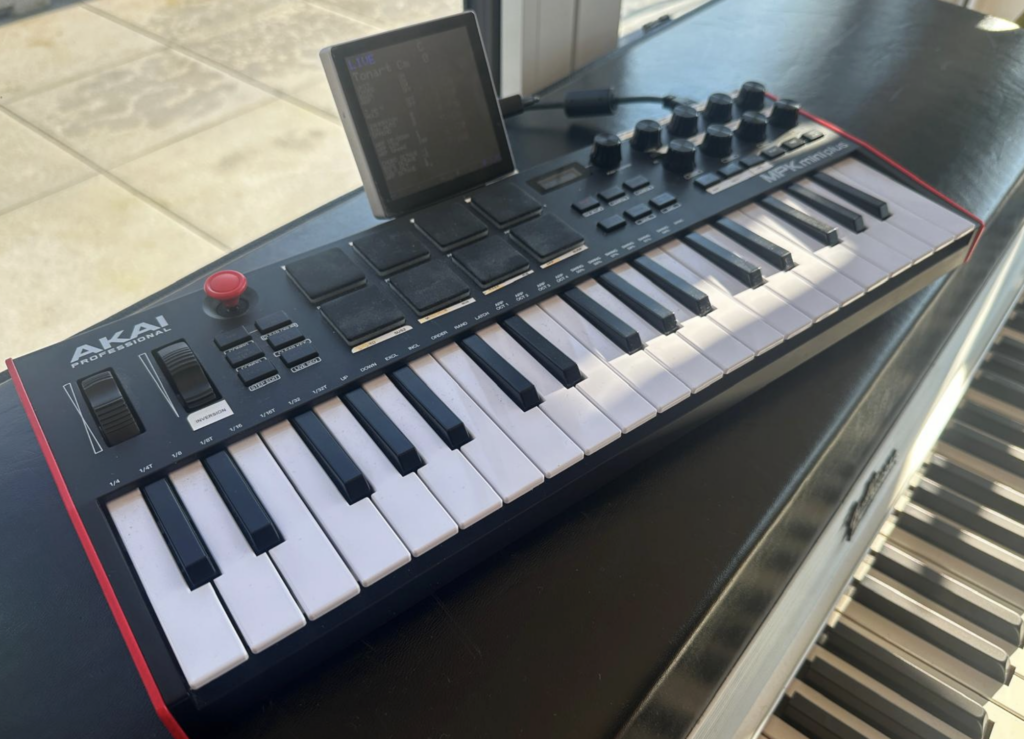
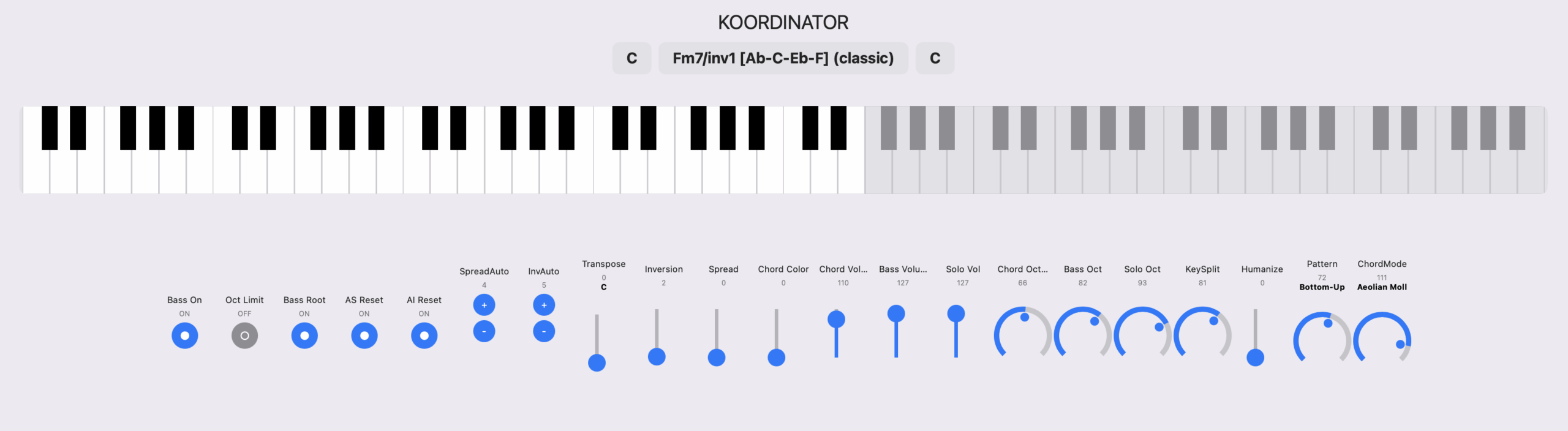
Midi Controller Keyboard with Chordinator Hardware , and as MacOs Software
What does Chordinator:
It helps making Music. So , please listen:
What is Chordinator:
Chord-O-Matic is a Midi Chord Processor.
Chordinator receives one MIDI Channel from your Midi Controller Keyboard.
It sends three MIDI-Channels for Chords, Bass and Solo.
It creates Chords and Bass and transposes your Solo Notes in the current Chord Scale.
Motivation
iI think that there is a missunderstanding of „i want to learn piano“ between students and the music teachers.
The student : „I want to make music“
The Teacher may want you to master the instrument, by learn how to read music, and make you play from sheet
So this is about making music.
If you listen to a pop tune, it is often made from just a few basic chords. And the melody follows the chords. There is some Theory *1),*2) behind all this. But basically you need to know the key of the song (eG.:C maj) and the Chord Progression. These are named with roman letters I to VII – Symbolising the seven white Keys on the Keyboard.
Like in Jazz Music, a song is then written as Sequence of Chords: eg: 1,4,6,5. or „officially“ as : I,IV,VI,V, in Roman Letters
Now there are two options:
- You learn all Chords and their building notes and corrosponding scales by heart to improvise your melody or
- you use Chordinator!
Chordinator generates a Chord from a single Note, and allows to improvise on the upper half of the Split keyboard, by transposing to the selected chords note. This avoids all black keys, transcriptions and sharps… Sounds cool …?
It really is! And there are some options to add variations of the chords so this automated approach does not sound boring.
Theory of Operation
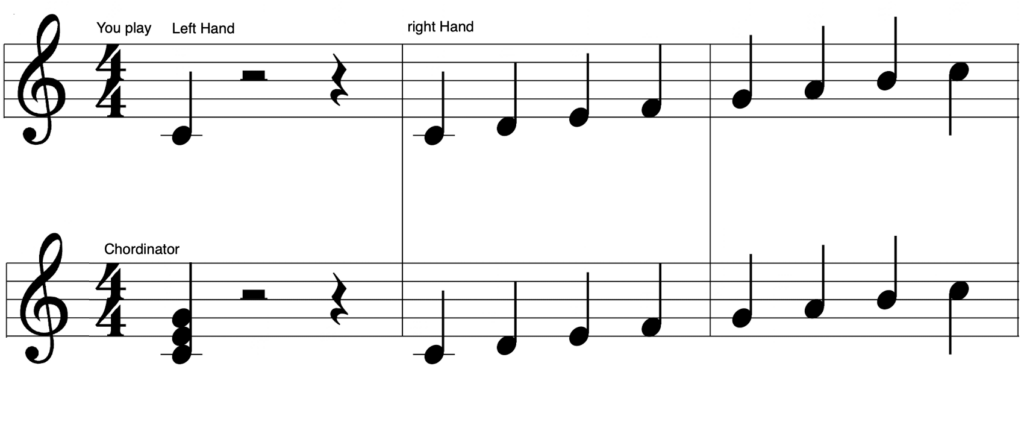
Assume you are in C Major. Pressing C (left Hand) creates Chord C Maj.
And your Solo Keys (right Hand) are C,D,E,F,G,A,B,C, as expected:
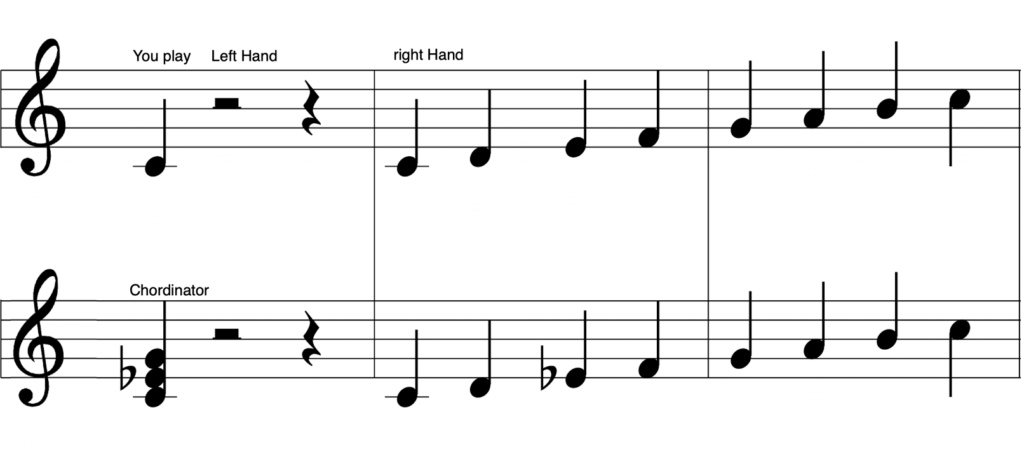
If your Scale is C minor, Chordinator will create a C minor Chord. And your Solo Keys are transposed from C,D,E,F,G,A,B, to C,D,Eb, F,G,A,B,C.
BUT: You still keep playing E instead Eb with your right hand. And the Chordinator will transpose E to Eb according to the Cminor Scale:
This works through all Keys and Scales:
If you play C Note in G minor Scale, A G Minor Chord will be generated
Your Solo Scale will transpose from C,D,E,F,G,A,B to G,A,Bb,C,D,Eb,F
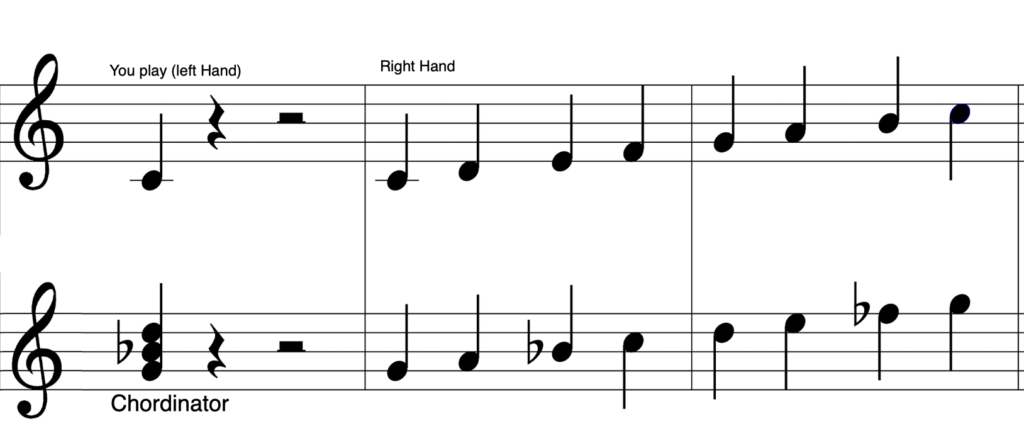
If you are in Key of Gmin , and change the Chord to 5, which is Dm.
The Solo Scale is also transposed to the Scale of Dm:

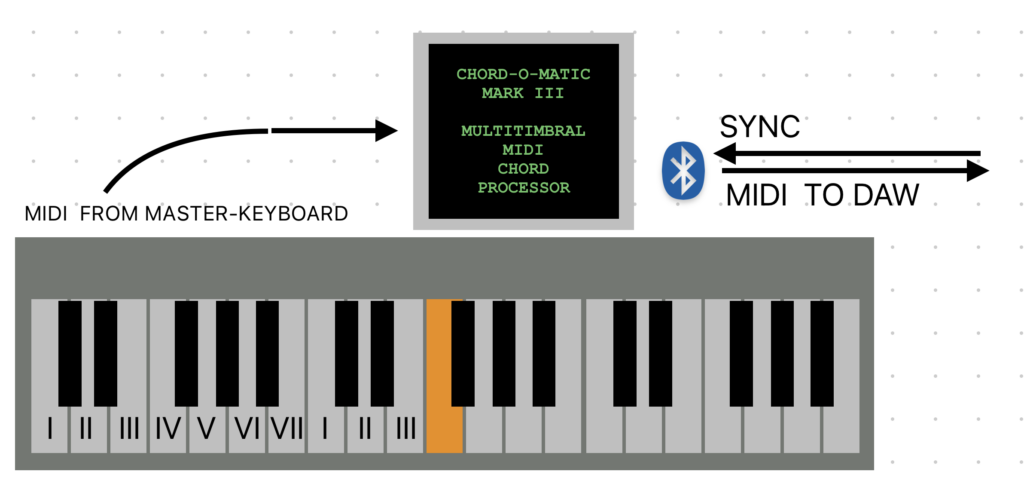
Basic Operation principle: Chord-O-Matic receives Midi from a keyboard, calculates chords and sends Midi Data to a DAW.
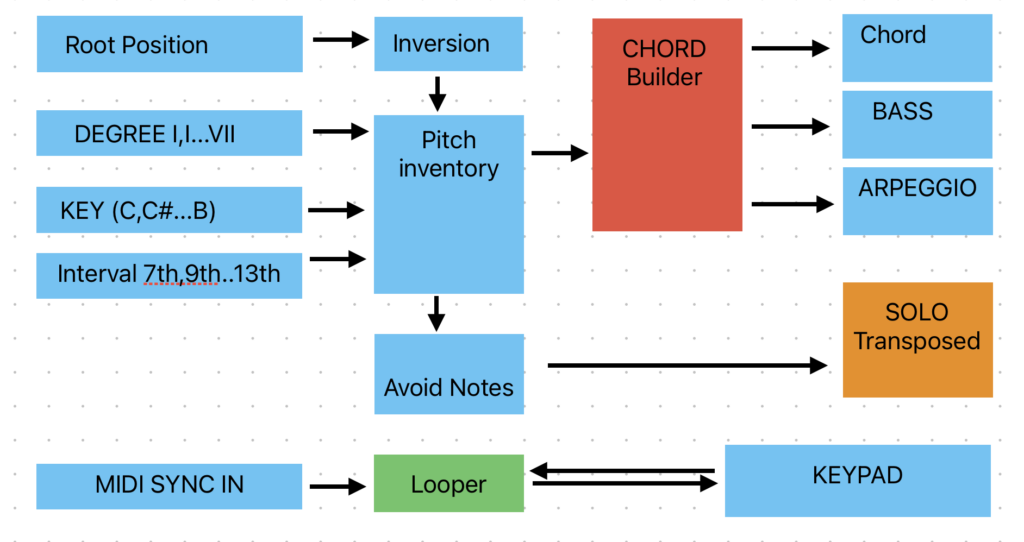
AutoChord consists of five Main-Blocks:
- 1. The Chord-Builder
generates Chords based on the tonal scale theory for a selected major or minor key. Based on a Split Keyboard approach,
the left part of the Keyboard is used for Chord Builder.
White Keys – Steps 1 to 7 – provide the selected Chords from a tonal scale. While the black keys provide modifications used to enrich the available chords set.
Theory of Operation
The composed Chords are minor, major or dimished Triads.
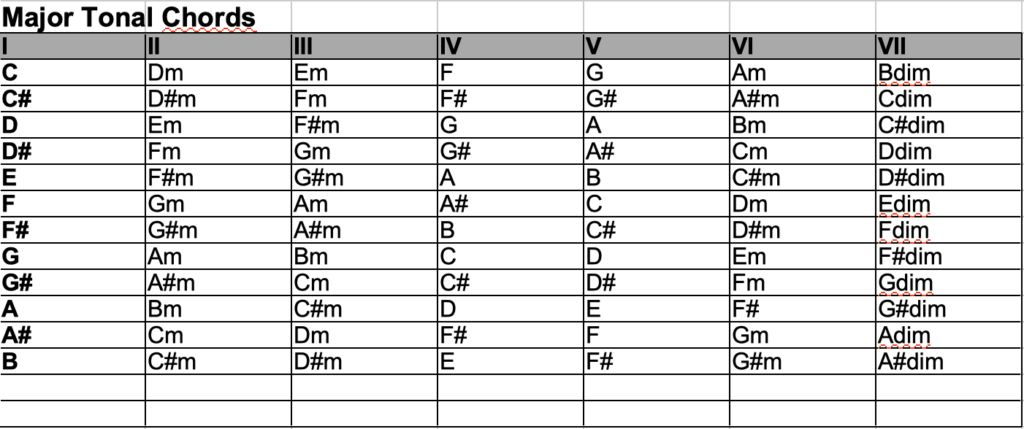
Audio of Major Tonal Scale I-VII
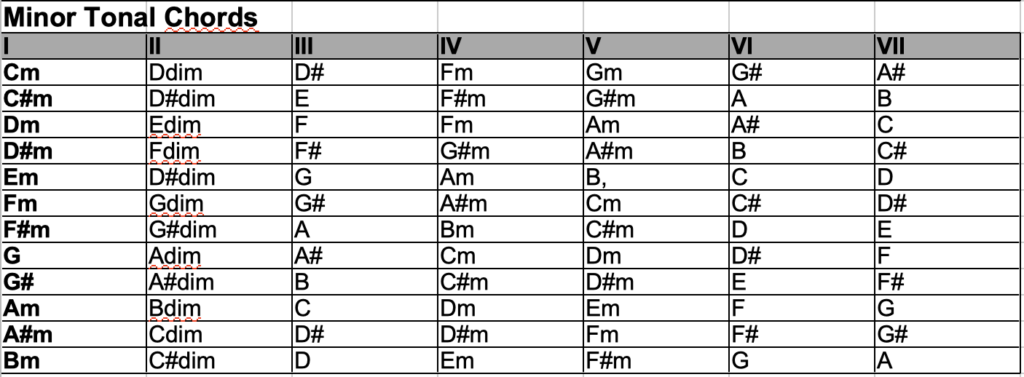
Audio of Minor Tonal Scale I-VII
With the SPREADER the chords change from Triads to 7th, 9th, 11th or even 13th.
Audio Sample of Minor Chords Cm, Cm7th, and Cm9th
The INVERSION shifts the base note of the chord seamless through the complete scale.
All done by press of a single Key.
Some Modifier Buttons allow to change the Chord to Sus2, 4 or others for even more options.
2. The AutoBass Block
adds the corrosponding BASS NOTE in the root. It gererates a suitable bass note in a separate MIDI channel to provide a solid foundation.
3. The ARP-Module
can use the complete range of scale notes for ARPEGGIOS. Routed on a seperate Channel and based on various spread, inversion and patterns, it provides a ground for a a wide base of innovative sound carpets.
4. The improvisor / Solo Block
This is the most fun: It transposes your solo – based on the current scale and chord – converting every dimished, major or minor scale into C Major! – Simplifying your play and concentrate on the melodic flow. It may assist in play or avoid notes not found in the current scale.
Of course you can choose a untransposed keyboard – based on the selected scale – which assists improved keyboarders with a standard and blues scale on another MIDI channel.
5. The Looper
catches a part of your play to assist your own accompaniment.
1.2 Auto inversion / Auto Spread
Choosing Auto Inversion changes the Inversion of the chord at every Keystroke, up to a maximum inversion (eg.5). If the maximum inversion is reached, it decreases again to zero, the base.
Choosing Auto Spread, changes the grade of the Chord from 5th,7th to 9th, depending on the maximum setting. Eg if selected Spread 1, the keyboard changes between Cmaj and C7maj at every Keypress. If maximum Spread 2 is selected Chord-O-matic generates Cmaj, Cmaj7, Cmaj9, Cmaj7 and Cmaj.
These two settings generate new chords at every Keystroke, allowing expressive and variant play.
„Gold“-Kadence made of Keys 1-7, no other Key pressed.
4.2 Auto Transposer in the upper Keyboard
Similar to a Guitar, where you select he Chord with the left Hand , and play single notes with the right hand, the Auto Transposer shifts all notes relative to the current chord. This simplifies the acomapainment and improvisation. Simply select cords I-V-VI-V with the left hand. This transposes the 4 times I-III-V Sequence played on the right hand into CEG, FAC, ACE, and GBD – in any scale:
Audio Sample of automatic transpose relative to chord progression. This Example is played with the Progression 1465 in the left hand, and only Notes CDE in the right hand:
*1) https://en.wikipedia.org/wiki/Chord_progression
*2) https://de.wikipedia.org/wiki/Stufentheorie_(Harmonik)
Notationssystem
Die relative Chord-Notation ermöglicht es, Songs unabhängig von der Tonart zu notieren. Alle Melodie- und Bass-Noten werden relativ zum aktuellen Akkordgrundton angegeben.
- Akkorde: Römische Ziffern (I, IV, V, vi, i, VI, etc.)
- Noten: Zahlen 1-8 relativ zum Akkordgrundton
- Skala: 1=Grundton, 2=Sekunde, 3=Terz, 4=Quarte, 5=Quinte, 6=Sexte, 7=Septime, 8=Oktave
- Vorteile: Transponierbar, zeigt harmonische Beziehungen, ideal für Pattern-basierte Musik
Stand By Me
Sweet Dreams (Are Made of This)
Lessons in Love
Every Breath You Take
Beispiele
Ich bin begeistert und schwer beeindruckt! Wer hatte nicht schon immer das Gefühl, dass eingängige Melodien gar nicht so viele Freiheitsgrade haben wie von den vielen Tasten suggeriert – Ein paar Soundbeispeile wären noch nett